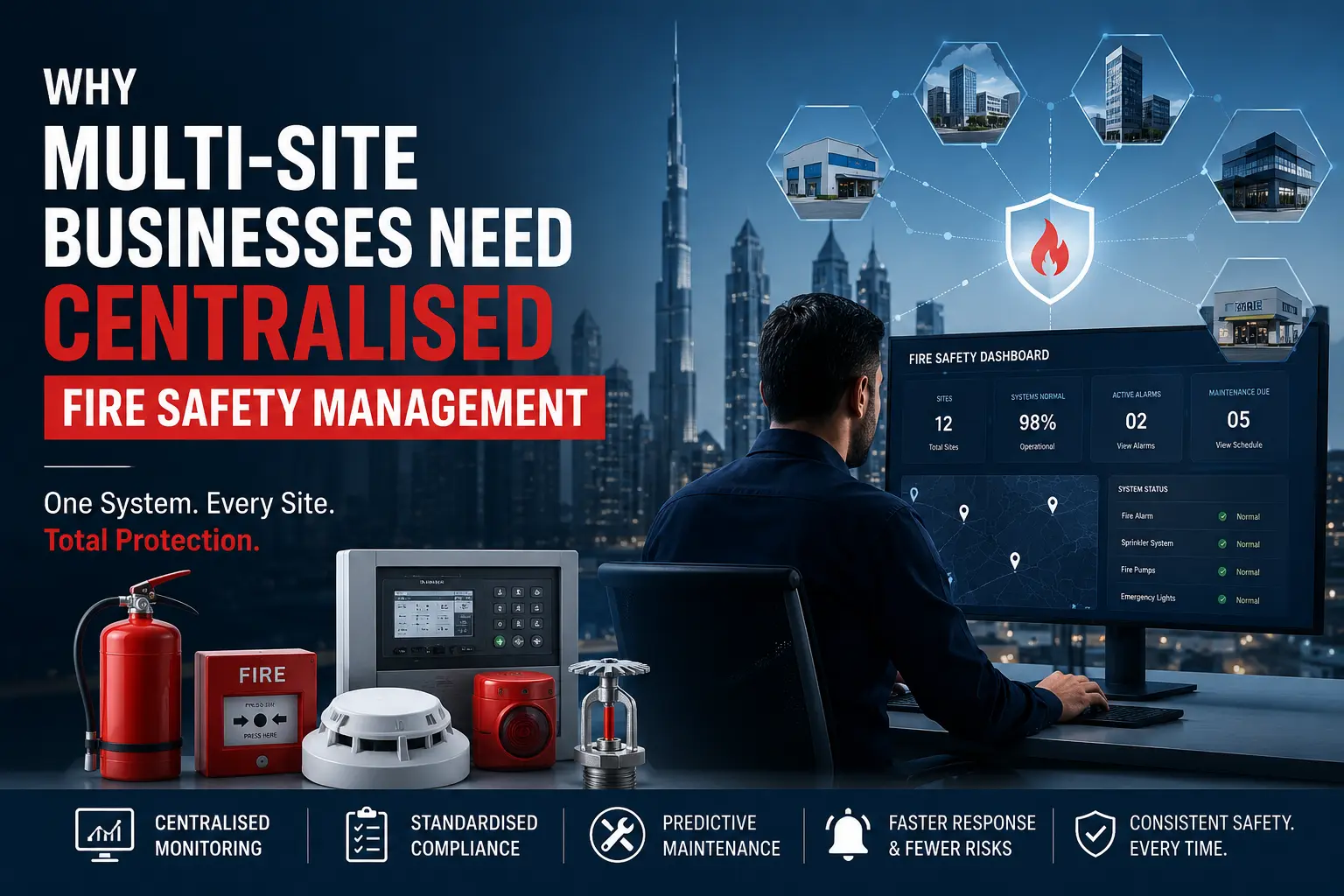
Managing fire safety in one building is already a major responsibility. Managing it across multiple warehouses, offices, retail outlets, industrial facilities, or commercial towers is far more complex.
As businesses expand across Dubai, fire safety operations often become fragmented without realising it. Different branches may use different contractors, maintain separate documentation styles, follow different maintenance schedules, or respond to faults in different ways. Over time, these inconsistencies create operational gaps that become difficult to control centrally.
For modern organisations, fire safety is no longer just about installing systems and passing inspections. It is about maintaining consistent protection, visibility, and compliance across every location at all times.
This is why many organisations now work closely with experienced fire & safety companies in Dubai to centralise maintenance, monitoring, reporting, and operational coordination under one structured system.
The Real Challenge of Managing Multiple Facilities
As operations grow, managing fire protection separately at each location becomes increasingly difficult.
One site may complete inspections on time while another delays rectification work. One branch may maintain accurate compliance records while another struggles with unresolved faults or incomplete reports.
Individually, these may look like small operational issues. Across multiple locations, however, they create larger risks such as:
- Compliance inconsistencies
- Delayed maintenance response
- Reporting gaps
- Increased operational exposure
- Higher administrative pressure
For organisations managing logistics hubs, retail chains, hospitality properties, industrial facilities, or multi-building developments, decentralised management often becomes inefficient very quickly.
This is why many large businesses prefer working with experienced fire & safety companies in Dubai that can manage multiple properties through a more organised and centralised maintenance approach.
Why Centralised Fire Safety Management Matters
The biggest advantage of centralisation is visibility.
Instead of every site operating independently, management teams gain one clear overview of:
- Alarm system status
- Maintenance schedules
- Fault history
- Inspection records
- Testing reports
- Emergency response coordination
This allows issues to be identified earlier and managed more consistently across all facilities.
More importantly, it reduces the likelihood of critical maintenance gaps remaining unnoticed until an inspection, audit, or emergency occurs.
Creating Consistent Compliance Across Every Location
In Dubai, fire safety regulations continue to evolve under strict Civil Defence standards. Managing compliance separately for every branch becomes harder as businesses scale.
Centralised management helps standardise:
- Inspection procedures
- Maintenance quality
- Reporting methods
- Testing schedules
- Compliance documentation
Rather than every location following different processes, businesses operate under one structured safety framework.
Many established fire protection companies in Dubai now support large organisations through unified AMC structures designed specifically for multi-site operations.
Experienced fire & safety companies in Dubai also help businesses maintain more consistent inspection standards, documentation quality, and reporting processes across all facilities.
Changing Compliance Standards Require Better Coordination
Fire safety expectations across Dubai’s commercial sector continue to become more advanced and technology-driven. For businesses managing multiple facilities, keeping every site aligned with updated standards, inspections, and maintenance requirements can quickly become difficult without central coordination.
A centralised approach helps organisations:
- Track compliance updates more efficiently
- Coordinate inspections and upgrades
- Maintain consistent documentation
- Reduce delays in rectification work
- Improve long-term operational control
Without central oversight, maintaining consistency across multiple facilities becomes significantly harder over time.
The Growing Role of Hassantuk and Smart Monitoring
Dubai’s fire safety infrastructure is becoming more interconnected through platforms such as Hassantuk, which enables real-time system monitoring and direct communication with Civil Defence control centres.
This infrastructure allows real-time monitoring of:
- Fire alarm activity
- System faults
- Emergency alerts
- Fire pump status
For businesses operating across multiple facilities, centralised internal monitoring works alongside this system by helping teams:
- Detect recurring issues earlier
- Coordinate maintenance faster
- Monitor alarm activity remotely
- Reduce unnecessary false alarm incidents
As smart infrastructure continues to expand across Dubai’s commercial sector, businesses are gradually moving away from reactive maintenance models toward more proactive and connected fire safety operations.
Today, several fire & safety companies in Dubai are adopting advanced monitoring systems and digital maintenance reporting to help commercial facilities detect potential issues before they become major problems.
Moving Beyond Traditional AMC Maintenance
Traditional maintenance models usually depend on scheduled inspections alone. But many large organisations are now shifting toward predictive maintenance strategies.
Modern addressable systems can identify:
- Individual faulty detectors
- Sensitivity drift
- Environmental issues caused by heat, dust, or humidity
- Early-stage equipment failures
In Dubai’s climate, where environmental conditions can directly affect system performance, this level of monitoring becomes highly valuable.
Instead of waiting for quarterly inspections to uncover faults, centralised teams receive early alerts and can resolve issues before they become compliance risks.
For businesses managing multiple facilities, this creates a more reliable and efficient Fire system AMC structure.
Reducing False Alarms and Operational Disruption
Frequent false alarms are increasingly creating operational challenges for commercial facilities across Dubai.
Repeated false activations can:
- Disrupt daily operations
- Affect occupant confidence
- Trigger unnecessary emergency responses
- Increase compliance pressure
In some cases, repeated non-compliance or unmanaged false alarms may also result in regulatory penalties.
Centralised monitoring allows businesses to verify issues faster and respond more effectively before disruptions escalate.
Because of this, many businesses choose to partner with established fire & safety companies in Dubai that can provide unified monitoring, maintenance management, and compliance support for multiple facilities.
Fire Safety Is Becoming a Business Value Indicator
Fire safety today is no longer viewed only as a compliance requirement. Increasingly, it is becoming part of how buildings and operations are evaluated commercially.
Investors, insurers, and property stakeholders now pay closer attention to:
- System reliability
- Digital monitoring capability
- Compliance consistency
- Maintenance quality
- Emergency readiness
Buildings with stronger operational safety standards are often viewed as lower-risk and more professionally managed assets.
For multi-site organisations, centralisation creates better visibility and control across the entire property portfolio.
This is one reason many fire protection companies in Dubai are expanding their focus beyond installation and maintenance into integrated operational support and monitoring.
Training and Operational Consistency Matter Too
Technology alone cannot manage emergencies effectively.
Preparedness still depends heavily on how people respond during real situations.
For multi-site operations, one major challenge is maintaining consistent safety standards across different branches and teams.
Centralised management helps standardise:
- Emergency response procedures
- Safety drills
- Reporting processes
- Staff awareness programs
This creates a more consistent level of readiness across all facilities instead of relying entirely on site-level practices.
Preparing for the Future of Smart Fire Safety
Dubai continues to invest heavily in smarter and more connected infrastructure.
Modern fire safety systems are increasingly integrating:
- IoT-enabled monitoring
- Cloud-based reporting
- Central dashboards
- Predictive maintenance tools
- AI-assisted diagnostics
Businesses that centralise fire safety operations today are building a stronger foundation for future operational resilience.
Many organisations are effectively moving toward what industry professionals describe as a “digital twin” approach to fire safety — where system visibility across multiple facilities can be monitored remotely in real time.
Final Thoughts
Managing fire safety separately across multiple facilities may work temporarily, but as operations grow, the gaps become harder to control.
Centralised fire safety management creates:
- Better operational visibility
- Faster maintenance coordination
- More consistent compliance
- Improved readiness
- Stronger long-term control across all facilities
For businesses operating across Dubai, this approach is becoming less about convenience and more about operational necessity.
Because when multiple locations depend on the same level of protection, consistency matters just as much as the systems themselves.