

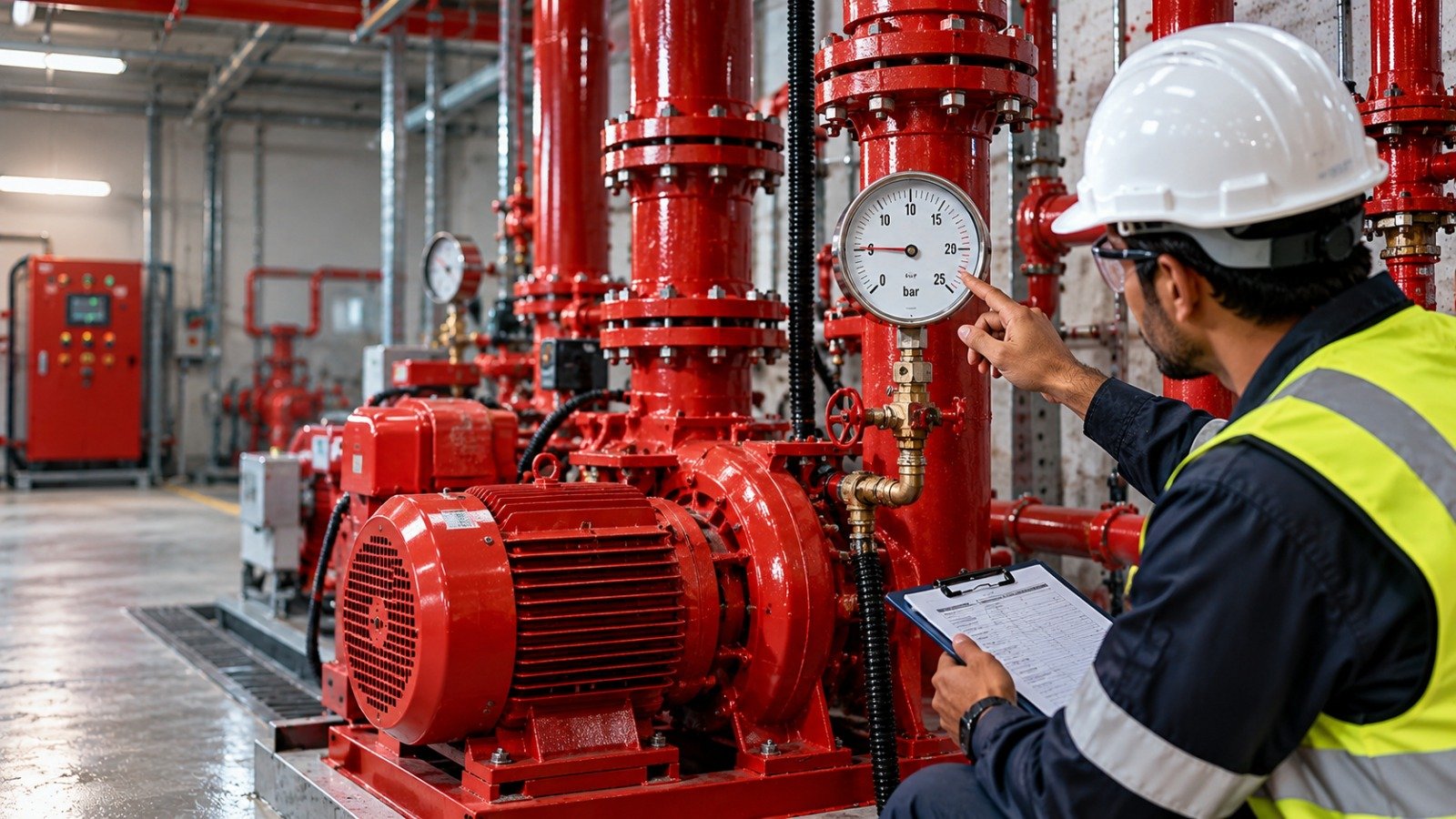
A sudden drop in fire pump pressure can indicate a problem that requires immediate attention. In commercial buildings, residential towers, warehouses and industrial facilities across the UAE, fire protection systems must deliver the required water flow and pressure during an emergency. If pressure falls below the level specified in the approved design, connected systems such as sprinklers, hydrants and wet risers may not perform as intended.
For facility managers, identifying the cause early is essential to maintaining fire safety and reducing the risk of system failure. A pressure drop may result from a water-supply problem, hidden leakage, incorrect valve positions, pump deterioration or a control-system fault. Understanding these possibilities helps maintenance teams investigate the issue systematically rather than making adjustments without identifying the underlying cause.
This guide explains the common causes of fire pump pressure loss, the initial checks facility managers can perform and the importance of professional fire pump maintenance in Dubai.
Why Is Fire Pump Pressure Important?
A fire pump is designed to supply water at the required flow rate and pressure for a building’s fire protection system. Its performance depends on several factors, including the water supply, building height, pipework resistance, valve arrangements and the hydraulic demand of the protected areas.
Facility managers should understand the difference between four common pressure measurements:
- Static pressure: Pressure measured when water is not flowing.
- Churn pressure: The pressure generated by the pump when no water is flowing through it.
- Flow pressure: The pressure recorded while water flows through an approved testing setup.
- Residual pressure: The pressure that remains in the system at a specific location while water continues to flow.
A pump may maintain acceptable pressure when no water is flowing but struggle during a performance test. Similarly, a satisfactory reading at the pump room does not necessarily mean that sufficient pressure is available at the most demanding point in a high-rise building.
For this reason, fire pump pressure testing should consider both the recorded pressure and the flow the system can deliver under the conditions specified by its approved hydraulic design.
Common Causes of Fire Pump Pressure Drop
Low Water Supply or Suction Restrictions
A fire pump cannot deliver its intended performance if the suction side cannot provide sufficient water. Low fire-water tank levels, a faulty tank-refilling arrangement, a partially closed suction valve or an obstructed suction pipe can restrict the available supply.
Sediment, corrosion and construction debris may also affect the water path. In some installations, unsuitable tank connections, air entering the suction line or inadequate suction conditions can contribute to fluctuating pressure and reduced pump performance.
What to check first:
- Fire-water tank level and refill status.
- Accessible suction valve positions.
- Visible signs of leakage or damage.
- Suction pressure readings during approved testing.
- Controller alarms related to water supply or pump performance.
If suction pressure falls significantly while discharge pressure also deteriorates during a controlled flow test, the water supply and suction arrangement deserve particular attention. A qualified technician should investigate the underlying cause before recommending corrective work.
Hidden Leaks in Fire Protection Pipework
Not every leak produces an obvious puddle. Small leaks in underground fire mains, sprinkler branch lines, wet-riser connections, hose-reel pipework, flanges and mechanical couplings can gradually reduce system pressure.
One useful warning sign is a jockey pump that starts more frequently than usual or runs for extended periods. The jockey pump maintains system pressure against minor losses; persistent cycling may indicate leakage, a faulty check valve or another pressure-maintenance problem.
Facility managers should compare current pump-start activity with previous maintenance records. Where pressure repeatedly falls while the system is not in use, a professional leak investigation may be required.
Incorrect Valve Positions or Unintended Water Discharge
Valve-related problems are among the issues worth checking early because they may occur after maintenance, construction or tenant fit-out work. A partly closed suction valve can restrict water entering the pump, while a partly closed discharge or zone-control valve may limit flow to downstream equipment. A test-header valve, drain or test-and-drain connection left open can also cause unintended water discharge.
Facility managers should verify that the accessible valves are positioned according to the approved drawings and established site procedures. A supervisory signal alone may not confirm that a valve is fully open or free from internal obstruction.
Do not operate or isolate critical fire protection valves without authorisation. Any adjustment must follow the approved site procedure and account for the effect on the entire fire protection system.
Jockey Pump, Pressure Switch or Controller Faults
The jockey pump, pressure switches and controller help maintain normal system pressure and coordinate pump operation. Incorrect pressure settings, obstructions in the sensing line, air trapped within the line, or a defective pressure transducer may lead to unreliable readings or cause the pump to start at the wrong time.
A leaking non-return valve may allow pressurised water to flow backwards, causing pressure to fall again after the pump stops. Poor coordination between the jockey pump and main fire pump may also lead to repeated cycling or unexpected operation.
Warning signs include:
- Frequent jockey-pump starts.
- Unusually long jockey-pump running periods.
- Unexpected main-pump activation.
- Variations between the pressure shown on local gauges and the readings displayed by the building management system (BMS).
- Recurring pressure-related controller alarms.
These symptoms require investigation rather than simply changing the pressure settings. Any adjustment must be reviewed against the approved design, equipment specifications and applicable requirements.
Pump Wear, Cavitation or Driver Problems
Over time, mechanical deterioration can reduce a pump’s ability to deliver its specified performance. Potential causes include impeller erosion, excessive wear-ring clearance, corrosion, damaged seals, bearing problems, shaft misalignment and internal obstruction.
Cavitation is another serious concern. It occurs when local pressure inside the pump falls sufficiently for vapour bubbles to form and collapse. This can cause unusual noise, vibration, fluctuating pressure, reduced flow and damage to internal components.
The pump driver may also contribute to pressure loss. Electric fire pumps can be affected by electrical supply problems, phase imbalance, motor rotation or controller faults. Diesel-driven pumps may experience issues involving engine speed, fuel supply, batteries, cooling or other engine components.
Fire Pump Pressure Drop in Dubai: Compliance and Maintenance
In Dubai and across the UAE, fire pump performance must be assessed against the approved system design, applicable authority requirements and relevant technical standards.
NFPA 20 addresses the installation of stationary fire pumps, while NFPA 25 covers inspection, testing and maintenance of water-based fire protection systems. The applicable editions, project specifications and local authority requirements should be confirmed for each installation.
Dubai Civil Defence guidance also emphasises that the fire pump set must deliver the required flow and pressure based on hydraulic calculations. The approved arrangement and installation requirements depend on the building and its design.
For high-rise buildings, pressure zones, building elevation and pressure-reducing valves deserve particular attention. In warehouses and industrial facilities, changes to storage height, materials, sprinkler layouts or operational hazards can affect the hydraulic demand. A pressure complaint may therefore indicate a wider system issue rather than a fault within the pump itself.
How Professional Fire Pump Maintenance Helps
Professional fire pump maintenance involves more than checking whether the pump starts. A thorough inspection should cover the water supply, suction and discharge connections, pump condition, drive mechanism, control system, and the connected fire protection network.
Depending on the reported fault, a qualified contractor may verify pressure instruments, inspect valves and sensing lines, examine electrical or diesel-drive performance, investigate leakage and conduct an approved flow test. The results should be compared with the manufacturer’s data, previous test records and the approved hydraulic design.
For UAE facilities, selecting an experienced Fire fighting company in Dubai can help ensure that pressure-related issues are investigated systematically and that corrective work takes account of applicable fire safety requirements.
Conclusion
A drop in fire pump pressure requires prompt attention, as it could be caused by water leakage, restricted water supply, mechanical failure, or a malfunction in the control system. For facility managers in Dubai and across the UAE, identifying the cause early, documenting pressure readings and arranging professional inspection can help prevent minor faults from developing into serious fire protection system deficiencies.
Regular maintenance, performance testing and compliance with approved hydraulic calculations are essential to keeping a Fire Pump Set ready for emergency operation. Partnering with a trusted Fire fighting company in Dubai can help facility managers identify pressure-related faults accurately and implement appropriate solutions to meet the building’s fire safety needs.