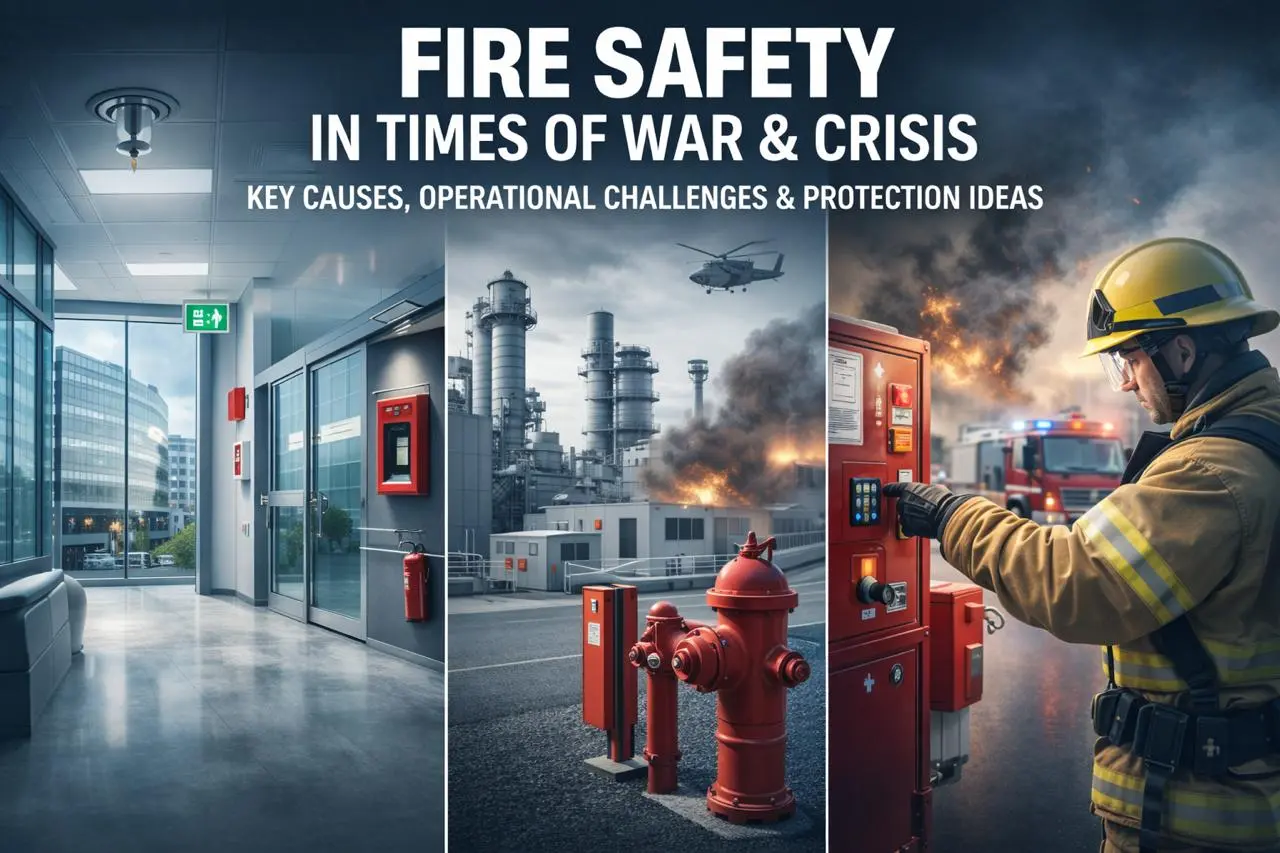
In times of uncertainty, attention usually shifts toward immediate threats. Fire risk, however, often builds quietly in the background.
Even when facilities are not directly affected, disruptions in power, operations, and infrastructure can create conditions where fire hazards increase without much warning. What would normally be a minor issue can escalate faster when systems are under stress.
Recent regional developments have brought this into focus. While not every incident directly impacts facilities, the surrounding instability highlights how fire risks during war or conflict-driven disruptions can extend beyond immediate zones.
For critical facilities such as industrial plants, warehouses, high-rise buildings, and infrastructure sites, fire safety in crisis situations becomes less about routine compliance and more about staying operational under pressure.
Why Fire Risk Changes During Crisis Conditions
Fire risks do not suddenly appear in crisis situations. They are usually already present, but the environment around them changes.
External Impact and Indirect Exposure
Facilities do not always need to be directly affected to face risk. Heat, pressure, or nearby disturbances can create ignition points in:
- Fuel or storage areas
- Electrical systems
- Exposed structural materials
In some cases, the source of ignition is not even within the facility itself. This is often observed when evaluating broader fire risks during war, where indirect exposure plays a major role.
Electrical Systems Under Strain
Power-related issues are one of the first things to shift during instability. Sudden outages, load fluctuations, or generator dependency can lead to:
- Overheating conductors
- Short circuits
- Equipment stress or failure
Electrical faults continue to be a consistent trigger for fire incidents in many environments.
Operational Disruptions and Human Factors
When normal routines are interrupted, small gaps begin to appear:
- Maintenance checks get delayed
- Temporary fixes remain longer than intended
- Storage practices become less controlled
These are not unusual during pressure situations—but they increase exposure to fire risk, especially in environments where fire safety in crisis situations depends heavily on consistent procedures.
Unpredictable External Factors
A newer layer of concern in certain scenarios is the effect of external debris or indirect impact. Even without direct damage, falling fragments or nearby activity can:
- Affect rooftop systems
- Damage exposed equipment
- Trigger localized ignition
This kind of risk is not always part of standard planning, yet it cannot be ignored.
Challenges in Fire Protection During Disruptions
Fire protection systems are built for reliability, but they depend on conditions that may not always hold during a crisis.
Access and Response Delays
Emergency response may not always be immediate. Access routes can be restricted or congested, especially in dense or industrial areas. Even small delays can affect how quickly a situation is contained.
Water Supply Uncertainty
Fire suppression systems depend heavily on water availability. During disruptions, pressure levels may drop, or supply may become inconsistent. This affects:
- Sprinkler systems
- Hydrant networks
- Firefighting operations
Facilities without internal backup face a higher risk.
Dependence on Power
Detection and alarm systems rely on stable power. Without proper backup:
- Alerts may not trigger on time
- Monitoring systems may go offline
- Coordination becomes slower
Limited Resources
In wider disruption scenarios, resources may be stretched:
- Fewer available personnel
- Delayed support services
- Reduced coordination
Facilities may need to manage initial response internally—something that becomes critical when addressing fire safety in crisis situations.
Practical Safety Measures for Critical Facilities
In these conditions, fire safety is less about adding more systems and more about ensuring existing systems continue to function when needed.
Reinforcing Structural Protection
Passive protection becomes more important:
- Fire-rated partitions
- Controlled zoning
- Properly maintained fire doors
These help limit the spread rather than relying only on suppression.
Ensuring Independent Water Systems
Facilities benefit from reducing reliance on external supply:
- On-site storage tanks
- Dedicated pumping systems
- Internal distribution networks
This adds a level of control during uncertain conditions.
Keeping Detection Systems Reliable
Detection must remain active regardless of external factors:
- Backup-supported alarm systems
- Multi-sensor detection
- Continuous monitoring setups
Early detection remains one of the most effective controls.
Maintaining Backup Power
Emergency power is not optional in such scenarios. It supports:
- Alarm systems
- Smoke control
- Emergency lighting
Without it, even well-designed systems may fail to operate.
Managing High-Risk Materials Carefully
Facilities handling flammable or sensitive materials should review:
- Storage practices
- Separation distances
- Environmental conditions
During disruptions, these areas often become more vulnerable—especially in scenarios linked to broader fire risks during war or regional instability.
Preparing On-Site Teams
Systems can only do part of the job. The rest depends on people.
Basic preparedness includes:
- Understanding alarm responses
- Using first-response equipment
- Knowing evacuation procedures
Training does not need to be complex—but it needs to be consistent.
Context: Fire Safety Expectations in the UAE
In the UAE, fire safety is closely tied to system reliability and continuous operation. Regulations are structured around ensuring that protection systems remain functional at all times.
This includes:
- Regular inspection and maintenance
- Approved installation practices
- Continuous system readiness
- Integration with monitoring frameworks
Facilities that maintain systems consistently—not just during inspections—are better prepared for unexpected situations, particularly when maintaining fire safety in crisis situations.
Closing Perspective
Crisis conditions tend to reveal where systems are strong—and where they are not.
A small fault that might go unnoticed in normal conditions can develop quickly when systems are under pressure. Delays, gaps, or overlooked details become more significant.
For critical facilities, fire safety in such situations comes down to one thing: whether systems continue to function when conditions are not ideal.
Because in uncertain environments, reliability matters more than design.